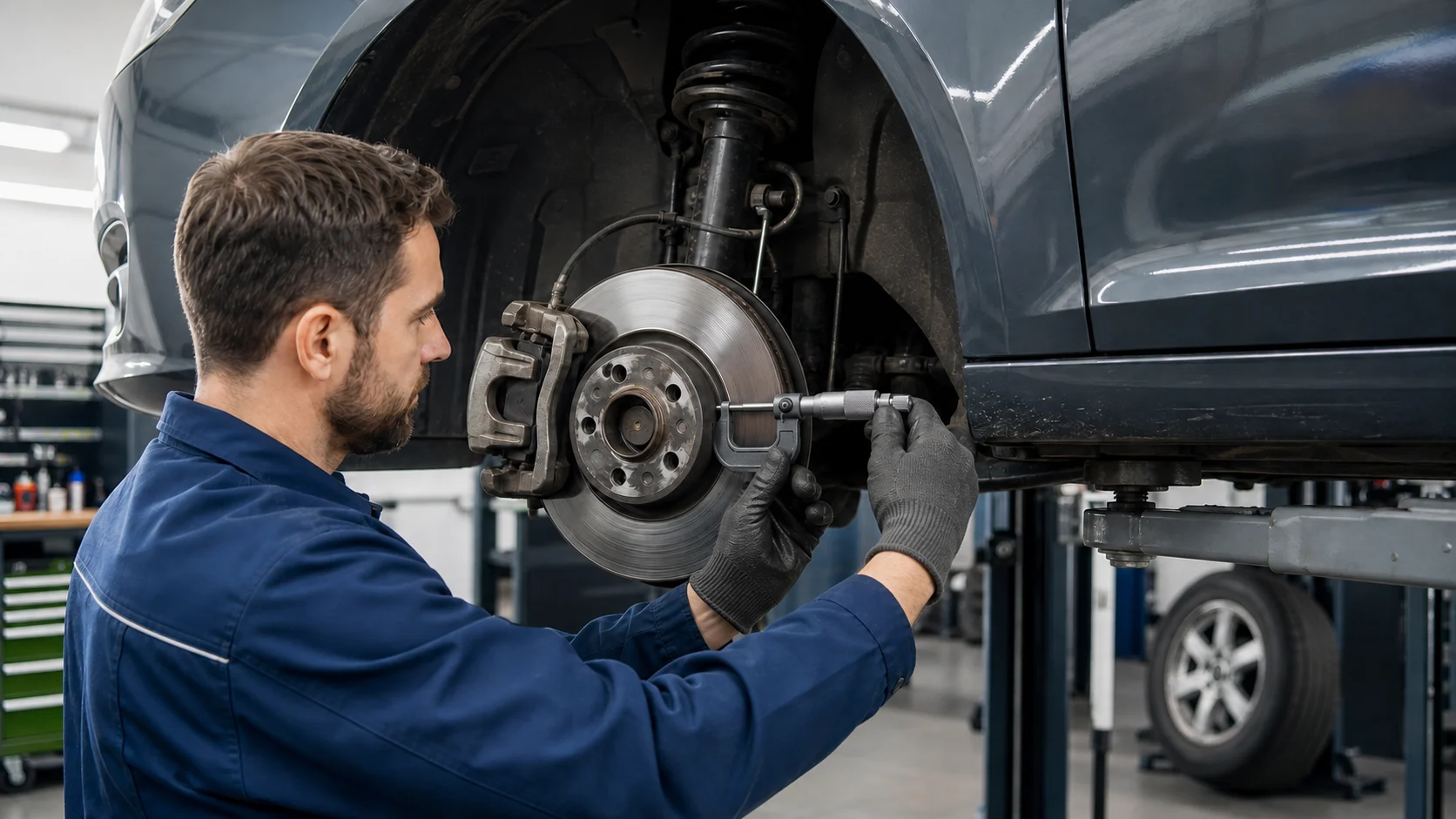
High-pitched squealing, pedal pulsation, longer stopping distances, or dashboard warning lights can instantly indicate brake wear. Technicians check pad thickness, brake fluid moisture content, and rotor runout when performing an inspection. The 3 mm wear point is a critical level to reach so the rotor can be replaced without high cost and highway stopping performance can be maintained.
Most auto blogs approach brake maintenance as merely a collection of sounds, and they forget that small delays compound repair costs. The data, from AAA and industry repair benchmarks, reveal a significant cost difference — a replacement done before the pads wear out is about half the cost of replacing the rotors when the pads wear down and score the rotor. Whether drivers are looking for Brake Repair Near Me, it’s important to know what mechanics actually measure because it can turn what would otherwise be a stressful estimate into a straightforward safety check.
Early Warning Signs Before Failure
There are certain sounds and feelings that indicate friction and hydraulic loss in your vehicle. The earlier these symptoms are identified, the more potential damage to hardware is avoided and the more predictable the stopping distances are.
- Metal Squealing: When a component of the friction material gets closer to 3 mm, the metal wear indicators on the rotor begin to rub against the steel, creating the squealing noise characteristic of metal-on-metal contact.
- Grinding or Growling: No friction material at all is remaining and the steel backing plates of the friction material are now in direct contact with the cast-iron rotors.
- Steering Wheel Vibration: Pulsing through the pedal and wheel at highway speeds as a result of uneven rotor thickness variation (disc thickness variation).
- Spongy Brake Pedal: Air pockets or moisture in the hydraulic fluid puff when applying the brakes rather than clamping the caliper.
- Pulling to One Side: A seized caliper slide pin or collapsed rubber brake hose will cause an uneven clamping force on the axle.
| Symptom | Primary Mechanical Cause | Urgency Level |
| High-pitched squeal | Wear tab on rotor surface welded to pad. | Schedule within 500 miles |
| Grinding metal noise | The rotor is scored with a backing plate to achieve zero friction. | Rushing; don’t go far |
| Sinking or soft pedal | Bypass of master cylinder, fluid leakage, or boiling of the fluid | Immediate; Tow if pedal touches floor |
| Pulse the pedal in a fast rhythm. | The causes of lateral rotor runout or a heat-spotted disc surface. | Check in 1-2 weeks. |
If there is any noticeable change, particularly if the pedal is feeling like it is going down, get it checked right away, not wait for your next oil change.
What Local Technicians Actually Inspect
Certified technicians perform a systematic multi-point check, not by ear. An in-depth brake inspection consists of six physical checks, as specified by the National Institute for Automotive Service Excellence (ASE), the organization that sets the standards for inspections.
- Pad Lining Measurement: Technicians check the remaining friction material in mm on the inside and outside of the pads with a calibrated gauge.
- Rotor Thickness and Runout Check: Using a micrometer, mechanics check the thickness of the rotor and compare it to the minimum discard thickness stamped on the rotor hat.
- Caliper and Slide Pin Mobility: Technicians check to see if caliper pistons retract easily and slide pins move freely without being bound by rust.
- Brake Fluid Moisture Testing: With an electronic tester or boiling-point strip, technicians test water absorption, and AAA states that while it is acceptable, internal lines can be corroded over time.
- Flexible Hose and Line Inspection: Mechanics inspect rubber hose and lines for dry-rot cracking, swelling under pressure, and steel lines for rust pitting.
- ABS and Parking Brake Verification: Check stored ABS fault codes and verify mechanical or electronic parking brake hold.
Always request your service advisor for the exact millimeter size of both inner and outer pads before ordering parts.
Pad Lifespan and Repair Cost Breakdown
The kind of brake compound is most critical, as well as vehicle weight and stop-and-go traffic. AAA’s automotive repair cost data shows routine replacement of the pads is $150 to $350 per axle, and the addition of rotors raises the price to $250 to $500 per axle.
| Service Scope | Typical Lifespan / Trigger | Average per-axle cost (AAA/industry data) |
| The ceramic brake pads are the only option. | 40,000–70,000 miles (replaced at 3 mm) | $150 – $350 per axle |
| Semi-Metallic Pads Only | 30,000–50,000 miles (heavy-duty/towing) | $150 – $325 per axle |
| Pads + New Rotors | A rotor that fails to meet minimum spec or has been heat-scored. | $250 – $500 per axle |
| Brake Fluid Flush | Every 2-3 years or whenever the moisture content exceeds 3%. | $90 – $150 total system |
Choosing reputable Brake Repair Near Me ensures technicians match the factory-recommended friction compound—ceramic for quiet daily commuting or semi-metallic for steep grades and towing—so stopping distances meet National Highway Traffic Safety Administration (NHTSA) safety benchmarks.
Proactive Care Keeps Stopping Power Reliable
Allowing grinding noises to occur can lead to a costly hydraulic and rotor overhaul procedure. Combined with documented millimeter readings, early awareness of symptoms can help you schedule repairs instead of making them on the job. Get your braking system checked annually during a tire rotation to ensure all stops are sharp, balanced, and reliable.
Frequently Asked Questions
How many mm of the brake pad is too much?
Most manufacturers and state safety inspections consider 2 mm or less unsafe. It is suggested that replacement be done at 3 to 4 millimeters, in order to avoid scoring your rotors.
Is it possible to change just brake pads, or do I have to change the rotors also?
Yes, if a micrometer is taken of the rotors and is verified to be within the manufacturer’s minimum thickness requirement and no deep grooves or lateral runs are found.
When should brake fluid be changed?
According to AAA, brake fluid is hygroscopic, which means it draws water from the air, and is recommended to be changed every two years or when tested for the presence of water in the fluid.
What is causing my new brakes to squeak a little in the morning?
Surface rust forms on cast-iron rotors because of overnight moisture; this typically dissipates through the first 2-3 normal stops you make.
Does hybrid/electric car regenerative braking eliminate brake service?
No; although regenerative braking decreases pad wear, heat of friction in the disc brakes also increases the risk of caliper slide-pin seizure and rotor rust, so it is necessary to have an annual inspection of the brakes.